
Surviving the Mud
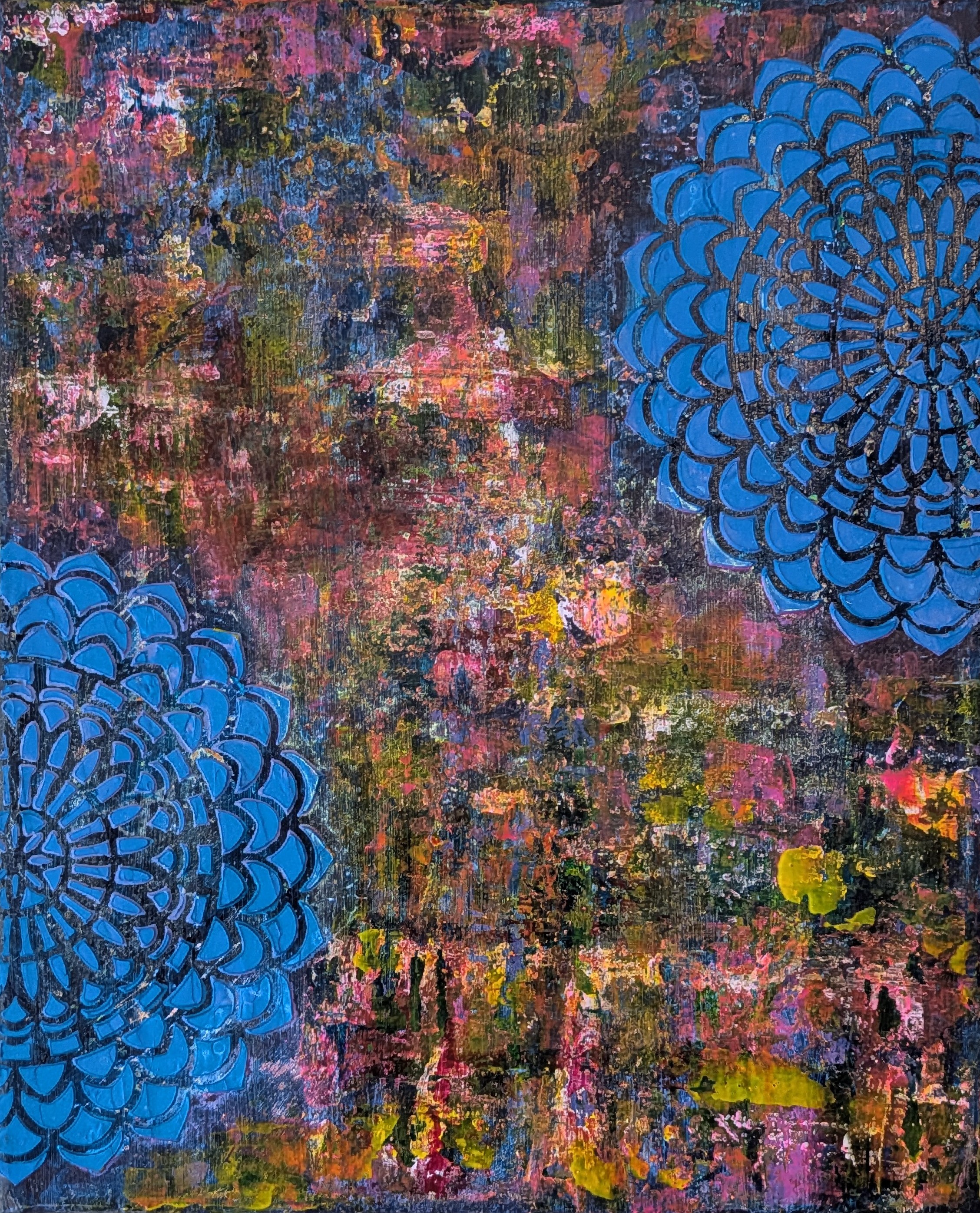 Some paintings find their way quickly. Others have to survive a little first.
7 July 2026
When I finally finished this painting, the song I’m a Survivor popped into my head. The very next lyric is:
“I’m not gonna give up. I’m not gonna stop. I’m gonna work harder.”
I couldn’t help but smile because I felt like that was exactly what this painting had done. We experienced a lot together.
As with many of the paintings I end up loving most, they rarely start out that way. I wish I could magically paint what I imagine on the very first attempt, but over time I’ve learned something important. If I call something a test canvas, I give myself permission to experiment, play, explore, and create without the pressure of producing something amazing right out of the gate.
This canvas became exactly that.
In fact, I think it holds more experiments than any other painting I’ve created so far.
Our journey began with paint... and sand.
My son had leftover colored sand from a craft project, and I wondered what would happen if I mixed it into acrylic paint. I loved the rough texture it created, but after that first experiment the painting sat quietly for months while I decided what to do next.
Eventually I dusted it off and decided it deserved another chance.
I had several small tubes of paint I wanted to use up, so I began building colorful layers with a palette knife. There were a few moments where I could have stopped, but curiosity got the better of me. Then I picked up a long toothpick and started drawing lines through the wet paint.
I knew almost immediately...
That was a mistake.
So I smeared everything together. And that’s when I got mud. It was official.
I had ruined it.
Oddly enough, that made the next decision much easier because I figured I certainly wasn’t going to make it any worse. So I kept experimenting.
More colorful layers followed until I reached another idea I wanted to try.
Sandpaper.
I covered the entire painting with transparent Greenish Blue and imagined using a brick stencil and sandpaper to reveal neat little bricks beneath the surface. It was a great idea. In theory. In practice... not so much.
The stencil shifted, the sanding barely worked the way I’d imagined, and instead of carefully revealed bricks I ended up with another unexpected layer in the painting’s history.
Looking back now, I’m glad it happened.
The cool transparent blues and textured surface briefly reminded me of the underground pools we had seen inside a cave during a recent trip. For a while I thought perhaps the painting wanted to become something mysterious and cavern-like.
But once again...
It wasn’t finished.
So I put my experiment hat back on.
This time I wanted to learn how to paint with bubbles.
I mixed pearl paints with water and a tiny drop of dish soap, blew bubbles through a straw, and gently dropped them onto the canvas. The results were fascinating. Each color left behind completely different marks.
I tried pearl violet. Then pearl green. Then pearl blue.
Some disappeared beneath later layers while others still quietly peek through today.
The painting continued to evolve.
I added modeling paste through partial mandala stencils, creating a raised texture that immediately changed the feel of the surface. At first I thought the mandalas would become the stars of the painting.
Instead, they became anchors.
Now my eye doesn’t stop on them. It wanders between them, discovering scratches, bubbles, glazes, textures, and little glimpses of earlier decisions buried beneath newer ones.
The painting isn’t really about the mandalas anymore. It’s about everything they have witnessed.
By this point I had started joking that this was simply another episode in The Adventures of Mud. No matter what I tried, the painting seemed determined to become muddy.
Eventually I stopped fighting that too.
Because even the mud became another layer.
I glazed transparent yellows and pinks across the surface to bring light back into the painting. I added more palette knife work. Sometimes I introduced opaque color only to scrape most of it away moments later.
Slowly...
Very slowly...
The painting began to breathe again.
Somewhere along the way I stopped asking, “How do I fix this?” Instead I started asking, “What happens if I try this?” That small shift completely changed the experience.
Instead of protecting the painting, I became curious about it.
Instead of trying not to make mistakes, I started collecting them.
Ironically, many of my favorite passages only exist because something else didn’t work first.
Looking at it now, I realize this painting isn’t really a collection of experiments. It’s a collection of second chances. Every layer I disliked became part of something I eventually appreciated.
Had I stopped after the mud...
Or the failed brick stencil...
Or the bubbles...
Or any of the moments where I was convinced I’d ruined it...
This painting would never have become what it is today.
Perhaps people aren’t so different.
Sometimes we carry every scrape, every failed experiment, every difficult season with us.
Not as flaws.
But as layers.
This little painting survived them all.
Survivor 27 × 22 cm