
An Experiment in Contrast and What Happened Next
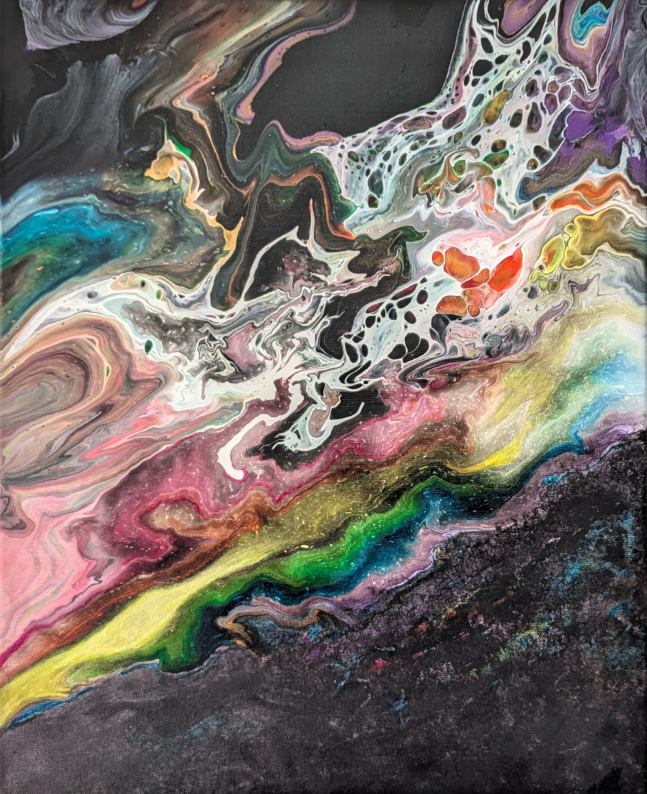 This post follows the evolution of a painting that began as a contrast experiment and grew
through layers of glazing, washes, charcoal and unexpected techniques. It is a reflection on
slowing down and shaping a piece with intention as it evolves.
This post follows the evolution of a painting that began as a contrast experiment and grew
through layers of glazing, washes, charcoal and unexpected techniques. It is a reflection on
slowing down and shaping a piece with intention as it evolves.
21 April 2026
I started this piece with a plan, but it became so much more than that.
I wanted to test something specific. I split the canvas into half black and half white and used the same rainbow colors across both halves. Then I swiped white through black and black through white to see how each would behave.
It felt controlled. Intentional. Almost scientific.
And for a little while, it stayed that way.
The first results were interesting, but also incomplete. The contrast was there, but the painting felt divided. More like a comparison than a composition. So I added more color and swiped again, this time across both sides. That was the moment it started to loosen. The structure I had set up began to dissolve into something much more fluid and connected.
That could have been the end of the experiment, but I was motivated to try more.
I sat with it for a while, unsure if I liked it. There was a lot happening. Too much, actually. Beautiful sections, but no clear place for the eye to rest. That is usually the point where I rush into fixing it and accidentally ruin it. This time I tried to do something different. I slowed down.
Instead of reacting, I started editing. Slowly and carefully.
I began to carve out negative space, darkening areas to give the rest of the painting room to breathe. That was the first shift from pouring to painting. It felt less like letting go and more like making decisions.
From there, I moved into glazing. This is still relatively new territory for me. I used thin layers of color to deepen some areas and bring others forward. It was subtle work, and also unforgiving. Acrylic does not wait for you. It dries quickly, and if you hesitate or try to fix something mid-process, it shows. I learned that the hard way when I pushed a section too far and had to pull back later.
There is something humbling about that. You think you are adding something small and suddenly it is the only thing you can see.
I also used washes to soften transitions and unify areas that felt too separate. Some of them worked exactly the way I hoped. Others took a few passes to settle into the painting. Each layer felt like a conversation. Add a little, step back, wait, then decide if it belongs.
The most unexpected addition was charcoal. Something about the painting was calling me to add it.
I used it in the lower portion of the painting to build texture and depth, then sealed it with fixative. It changed the feeling of that area completely. What had been a flat dark space became something more atmospheric. Less like a background and more like a place.
That might be my favorite part of the whole process. Not because it was perfect, but because it was unfamiliar. It reminded me that I don't have to stay inside one medium or one way of working.
Somewhere along the way, the painting stopped being about the original experiment.
It became about balance and bringing beauty to life.
About deciding what to keep and what to quiet down. About letting certain areas lead and asking others to step back. About resisting the urge to fix everything all at once and instead making small, deliberate changes.
I think that is what this piece taught me the most.
Not how to swipe or glaze or use charcoal, although I did learn all of those things. It taught me how to stay with a painting longer than is comfortable. How to let it change without rushing to resolve it. How to trust that the next layer might clarify something instead of ruin it.
I really love this piece now and all that it represents.
This piece started out as a controlled experiment, but ended up becoming more like a patient friend I could learn from and create something beautiful with.
Titled Magic Pegasus by my son, who saw a flying horse with rainbow magic streaming from it.